

WhatsApp:: +44 7557430838
Email: info@theoxfordcollege.com

The OTHM Level 5 Diploma in Information Technology is a UK-regulated qualification designed for learners who wish to develop practical and technical skills required for a successful career in the rapidly evolving IT sector. The programme is ideal for aspiring IT professionals, current practitioners seeking to enhance their knowledge, and learners wishing to progress to higher education or specialised IT careers.
The qualification provides a comprehensive understanding of core information technology disciplines, including IT fundamentals, systems and networking, database management, software development, cybersecurity awareness, and information systems. Combining theoretical knowledge with practical application, the programme equips learners with the technical competencies needed to design, develop, implement, and maintain modern IT solutions across a wide range of business environments.
Throughout the course, learners will strengthen their analytical, problem-solving, programming, and technical support skills while developing a solid understanding of emerging technologies and industry best practices. Graduates will be well prepared for employment in the IT industry or progression to higher-level qualifications and university degree programmes.
This qualification is assessed entirely through coursework and written assignments, enabling learners to demonstrate their knowledge and apply IT concepts to practical workplace scenarios.
Assessment methods include:
To enrol on the OTHM Level 5 Diploma in Information Technology, learners should normally:
The OTHM Level 5 Diploma in Information Technology is regulated on the Regulated Qualifications Framework (RQF) and is equivalent to the second year of a UK Bachelor's degree. The qualification comprises 120 credits and provides learners with a recognised pathway to Level 6 qualifications and university top-up degree programmes.
Upon successful completion of the OTHM Level 5 Diploma in Information Technology, learners may progress to:
The qualification consists of mandatory units totalling 120 credits.
The qualification is designed to be completed over one academic year through full-time study. Flexible blended learning delivery is also available, making the programme suitable for part-time learners, working professionals, and individuals seeking to develop practical IT skills while balancing work and personal commitments.
The OTHM Level 5 Extended Diploma in Business Management (June 2024 Specification), the entry requirements are:
Age: The qualification is designed for learners who are typically aged 18 and above.
Academic qualifications: Applicants should normally have at least one of the following:
A relevant Level 3 Diploma or an equivalent qualification.
GCE Advanced Level (A Levels) in two subjects or an equivalent qualification.
Mature learners (aged 21 and above) with relevant management experience. Such learners should check with the approved delivery centre to confirm that their experience is suitable before registering.
For course support, email support@theoxfordcollege.com or use the help centre inside your learner dashboard. Our support team is available Monday to Friday, 9am-5pm, and aims to respond to all queries within 24 hours.
Engaging in academic research and writing will help students to interpret and evaluate sources of information and evidence before becoming involved in the production of evidence based, logical, arguments. The aim of this unit is, therefore, to support the exploration of key topics which form part of the academic research and writing process so that learners will be able to achieve greater success and recognition in their studies.
Even though businesses are different in many ways, they do have some common features and are influenced by similar factors. This unit’s aim is to provide learners with the underpinning knowledge to contextualise and examine the fundamental factors which influence how a business operates within the context of its internal and external environment.
The effectiveness of a business’s approach to communication can often be critical to the achievement of strategic and operational objectives. The ways in which a business connects with its internal and external stakeholders, and overcomes different barriers to communication, will determine its short and long-term success. The aim of this unit is, therefore, to provide learners with the fundamental knowledge and skills to engage in meaningful and appropriate communication irrespective of the context in which the communication is located.
Having and effective finance and accounting function will not only help secure the financial strength of a business but will also support managers to develop and implement a business strategy. The aim of this unit is, therefore, to develop, in learners, the theoretical and applied knowledge to prepare, interpret and adjust financial statements alongside the preparation of budgets.
Having hard management and soft leadership skills is often stated by employers as being key to the success of a business but few people have sufficient quantities of both to make a significant impact on business operations and strategy. The aim of this unit, therefore, is to support a learner’s understanding of leadership as a role and management as a function so that they are able to develop the knowledge, skills and traits to make a meaningful contribution to a business’s success.
From a business perspective, the world is becoming a smaller place. Businesses need to be open to new ideas, new opportunities and a new way of operating. This means businesses need to expand and transform in what is a fast paced and dynamic environment. The aim of this unit is to encourage the exploration of key globalisation theories, concepts and models which will enable learners to gain an appreciation of the complexities of globalisation as well as the benefits globalisation presents to a business.
The Principles and Concepts of Strategy module explores the fundamental elements that guide strategic decision-making in organisations. It covers the analysis of internal and external environments, competitive positioning, and strategic resources and capabilities. Key frameworks such as SWOT, PESTEL, and Porter's Five Forces are examined to understand how they influence strategic choices. This unit also delves into the development and implementation of business strategies, emphasising the importance of alignment with organisational goals and the dynamic nature of the strategic landscape.
The ability to attract, develop and retain talented employees is a key factor in a business’s success. Human resource management has its focus on supporting and enhancing business success and performance through its strategic vision and operational functions. The aim of this unit is to introduce learners to the key human resource management principles and concepts so they can support a sustainable approach to people management through an understanding of the purpose and scope of the human resource management function.
The aim of this unit is to provide learners with a detailed understanding of the marketing planning process and to apply these principles to a variety of business contexts. The unit also provides a comprehensive understanding of environmental analysis and how this can lead to the development of appropriate objectives and strategies to enhance operational marketing performance.
All businesses and those employed by it must operate within the laws, legislation and regulations of the countries in which it conducts its activities. Some law only applies to specific types of business and their legal structure whereas other laws apply to any business irrespective of their operations and location. The aim of this unit is, therefore, to support a learner’s exploration of laws, legislation and regulations which apply in their home country and to different types of business.
Management accounting provides business managers with financial information required to achieve business objectives. This requires effective decision making based on the timeliness and accuracy of financial information. The aim of this unit is to provide learners with an awareness of the scope and purpose of management accounting, so they are able to support effective decision making within a business.
Many people dream of setting up their own business but are not aware of what is required, what support is available and what personal qualities are required. The aim of this unit, therefore, is to consolidate previous learning where learners employ the knowledge and skills of disciplines such as marketing and management to produce a viable business plan.

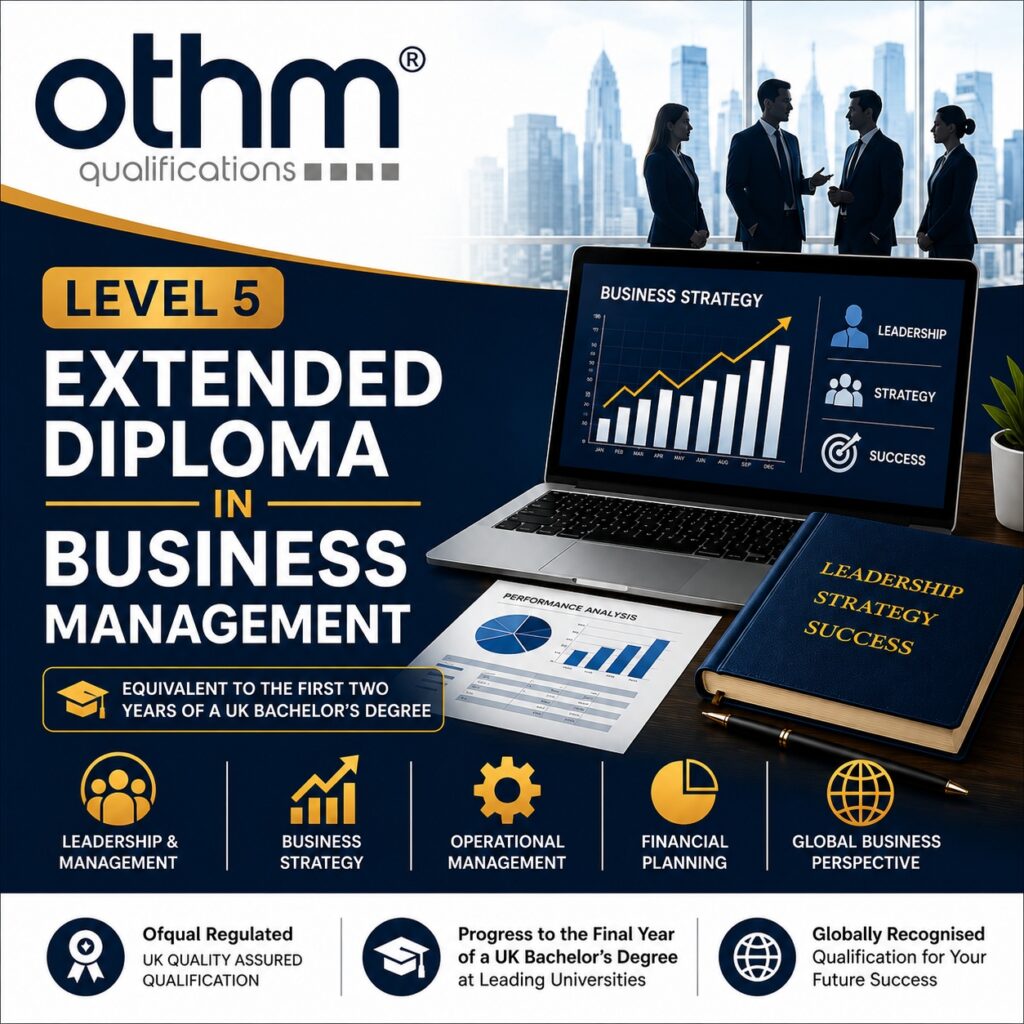
The OTHM Level 5 Extended Diploma in Business Management is an Ofqual-regulated UK qualification designed to develop practical business, leadership, finance, marketing, and management skills. It is equivalent to the first two years of a UK Bachelor's degree.
The qualification is assessed entirely through coursework and assignments. There are no written examinations. All assessments are internally assessed by the centre and externally verified by OTHM to ensure quality standards
Yes. Successful learners are eligible to progress directly to the final year (Year 3) of many UK Bachelor's degree programmes or continue to the OTHM Level 6 Diploma in Business Management, subject to university entry requirements.
The qualification is assessed entirely through coursework and assignments. There are no written examinations. All assessments are internally assessed by the centre and externally verified by OTHM to ensure quality standards
Yes. OTHM is a UK awarding organisation regulated by Ofqual (Office of Qualifications and Examinations Regulation). Qualifi qualifications are recognised internationally and are designed to support progression to higher-level study and professional development.
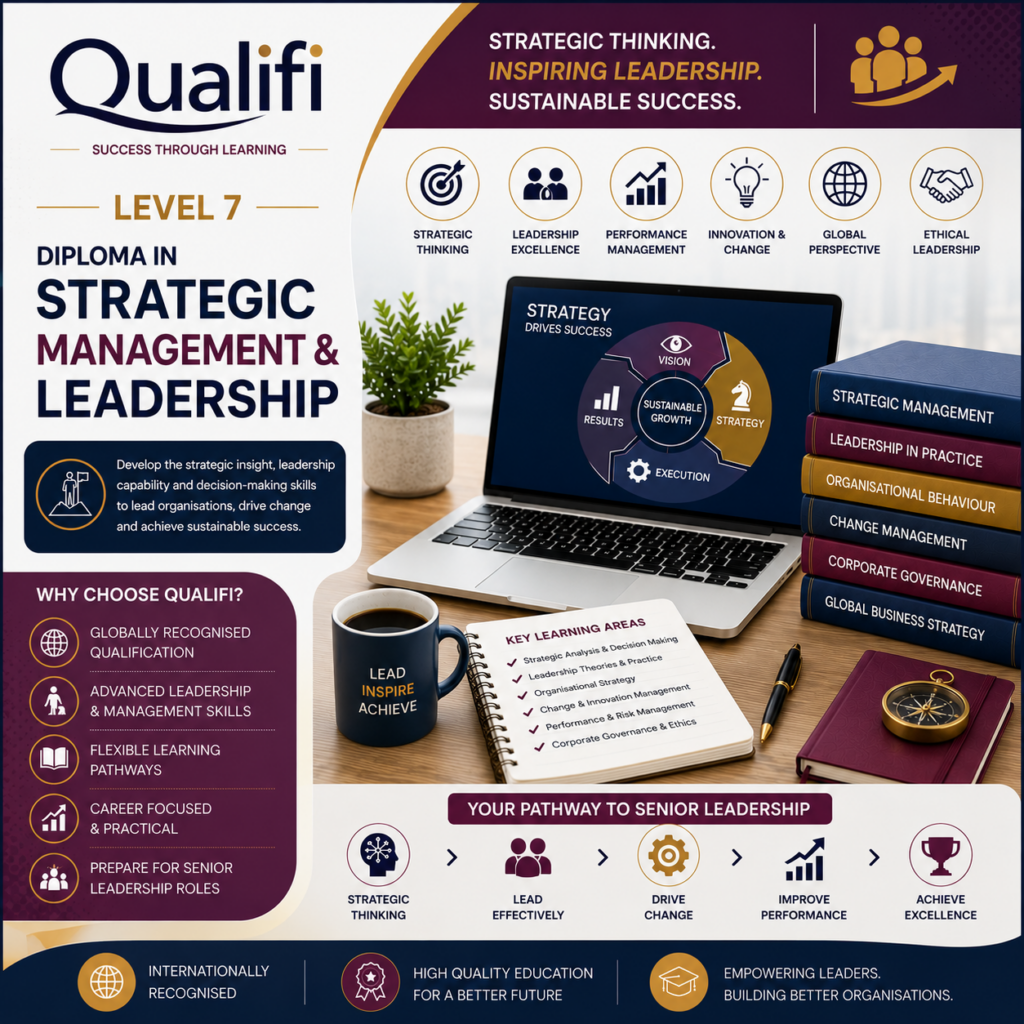
A comprehensive Qualifi Level 7 Diploma in Strategic Management and Leadership covering strategic planning, leadership, human resource management, business research, organisational change, and strategic decision-making for aspiring and experienced managers.
Entry requirements: For entry onto the Qualifi Level 7 Diploma in Strategic Management and Leadership qualification, learners must possess: An honours degree in related subject or UK level 6 diploma or an equivalent overseas qualification Mature learners with management experience (learners must check with the delivery centre regarding this experience prior to registering for the programme) Learners must be 21 years old or older at the beginning of the course English requirements: If a learner is not from a majority English-speaking country must provide evidence of English language competency.
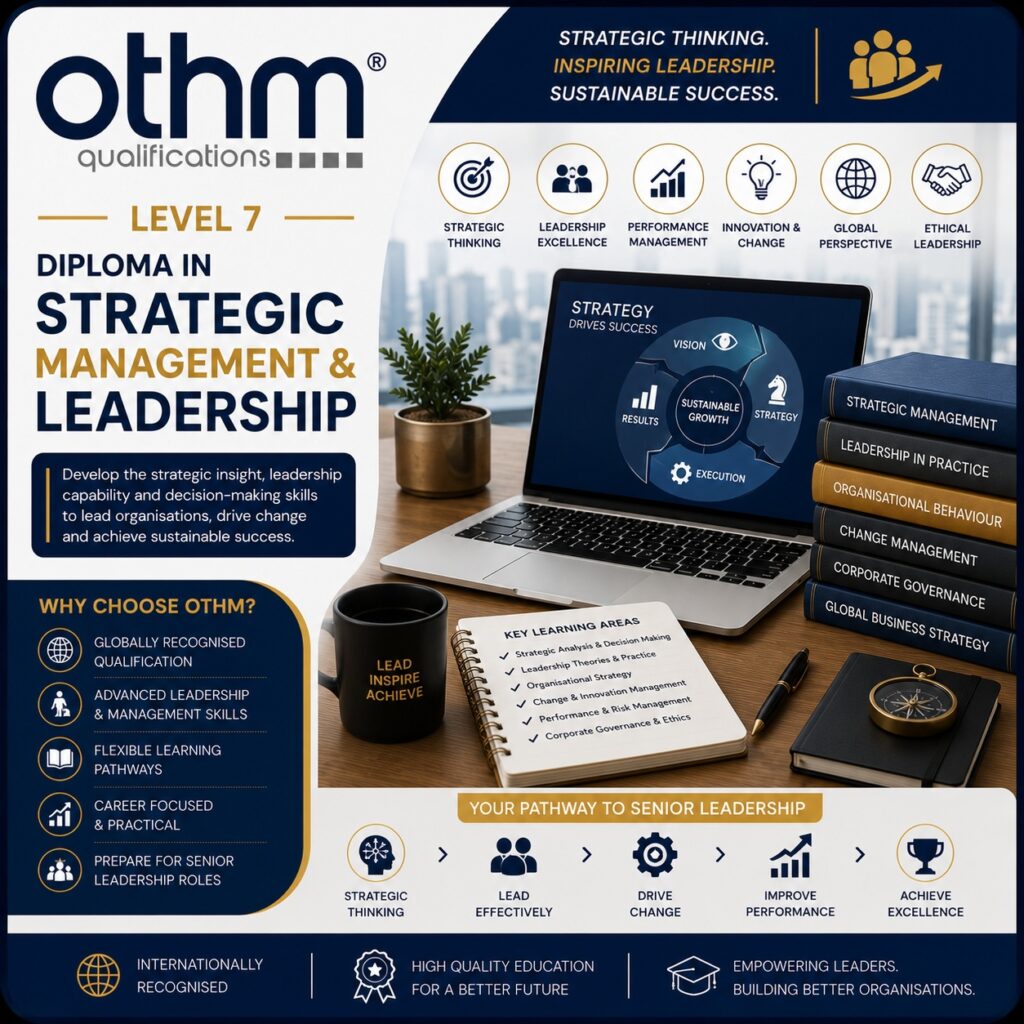
A comprehensive OTHM Level 7 Diploma in Strategic Management and Leadership covering strategic planning, leadership, human resource management, business research, organisational change, and strategic decision-making for aspiring and experienced managers.
Entry requirements: For entry onto the OTHM Level 7 Diploma in Strategic Management and Leadership qualification, learners must possess: An honours degree in related subject or UK level 6 diploma or an equivalent overseas qualification Mature learners with management experience (learners must check with the delivery centre regarding this experience prior to registering for the programme) Learners must be 21 years old or older at the beginning of the course English requirements: If a learner is not from a majority English-speaking country must provide evidence of English language competency.
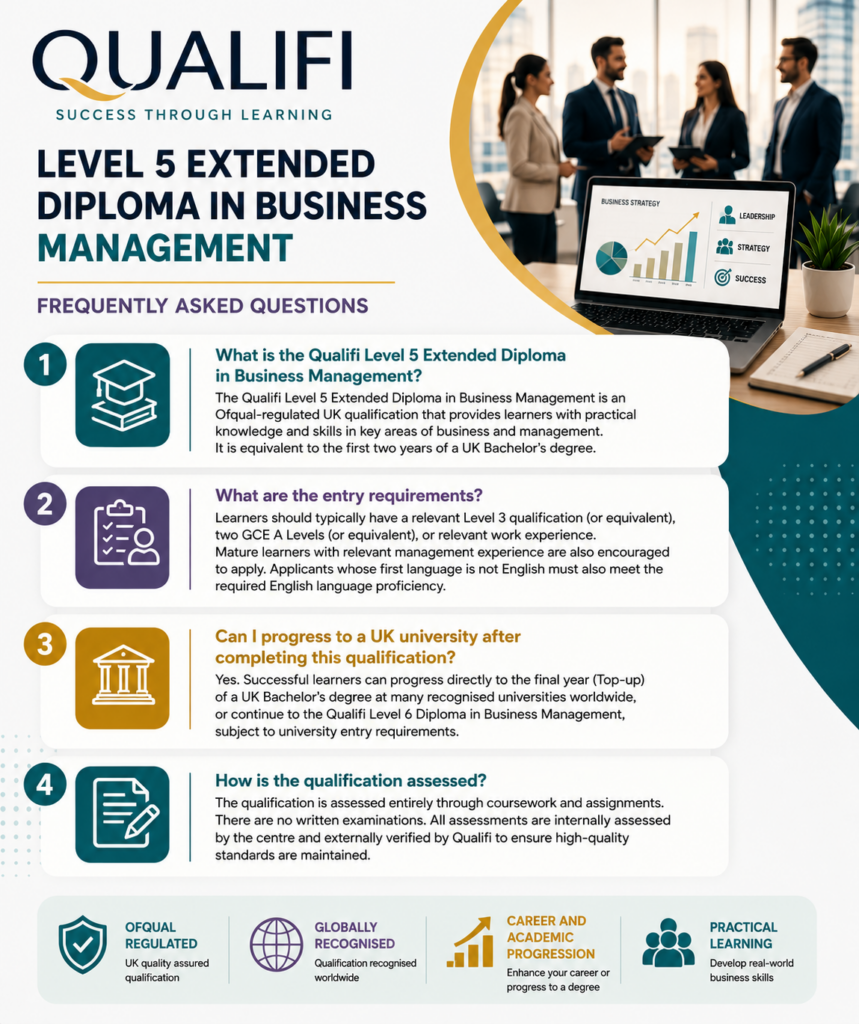
The Qualifi Level 5 Extended Diploma in Business Management equips learners with the practical knowledge, leadership skills, and business expertise needed to succeed in today's dynamic business environment. Covering key areas such as leadership, finance, operations, customer management, business development, and strategic decision-making, the qualification provides a strong foundation for career progression or progression to the final year of a UK bachelor's degree.
Entry requirements: For the QUALIFI Level 5 Extended Diploma in Business Management, the entry requirements are: Minimum age: Applicants must be 18 years or older. Academic qualification: Learners entering the Level 4 Diploma should normally hold a Level 3 qualification. Learners entering the Level 5 Diploma should normally hold a Level 4 qualification. English language: Applicants whose first language is not English must have IELTS 6.0 (or an equivalent Successful completion of the QUALIFI Level 5 Extended Diploma in Business Management provides learners with the practical knowledge, leadership skills, and commercial awareness required to pursue a wide range of careers in business and management across public, private, and third-sector organisations. Graduates may progress into roles such as: Business Manager Operations Manager Project Manager Human Resources Manager Marketing Manager Business Development Manager Customer Relationship Manager Office or Administration Manager Retail or Sales Manager Entrepreneur / Business Owner The qualification also provides an excellent pathway for learners wishing to continue their academic journey. Successful graduates can progress to the final year (Top-up) of a UK Bachelor's degree at a range of recognised universities or continue their professional development through higher-level management qualifications.English language qualification). International applicants: International qualifications will be assessed for suitability for entry to UK higher education programmes where applicable.

Reviews
There are no reviews yet.