WhatsApp:: +44 7557430838
Email: admin@theoxfordcollege.com


The OTHM Level 5 Extended Diploma in Information Technology is a UK-regulated qualification designed for learners who wish to begin or advance their careers in the IT and technology sector.
Regulated by Ofqual, the qualification combines practical knowledge, technical skills, and academic understanding at a level comparable to the second year of a UK bachelor’s degree. The programme covers key areas of information technology, including cybersecurity, computer programming, systems analysis and design, web and mobile application development, networking, digital information management, software engineering, database systems, management information systems, network information systems, and IT project management.
Throughout the programme, learners develop the practical and professional skills needed to become confident, independent, and workplace-ready IT professionals. The qualification supports progression to further university study and employment across a wide range of public- and private-sector organisations.
The qualification is assessed through coursework, written assignments, projects, presentations, and practical or laboratory-based activities. Learners are evaluated on their ability to apply technical knowledge and IT skills to realistic workplace situations.
Assessment methods may include:
Applicants should normally:
Mature applicants aged over 21 who have relevant work experience may also be considered.
The OTHM Level 5 Extended Diploma in Information Technology is regulated under the Regulated Qualifications Framework (RQF). It represents a level of practical knowledge, skills, and competence comparable to a Foundation Degree, Higher National Diploma (HND), or the second year of a three-year UK bachelor’s degree.
After successfully completing the qualification, learners may progress to:
The qualification comprises 12 mandatory units with a total value of 240 credits.
The qualification is normally completed through two academic years of full-time study. Flexible blended-learning options may also be available, allowing learners to balance their studies with employment, personal commitments, and professional-development goals.
Applicants should normally:
Be aged 18 or above
Hold a relevant Level 3 Diploma or an equivalent qualification
Hold GCE Advanced Level qualifications in two subjects or an equivalent qualification
Demonstrate appropriate English-language competency if English is not their first language
Mature applicants aged over 21 who have relevant work experience may also be considered.
For course support, email support@theoxfordcollege.com or use the help centre inside your learner dashboard. Our support team is available Monday to Friday, 9am-5pm, and aims to respond to all queries within 24 hours.
The aim of this unit is to provide learners with a deep understanding of the activities of the systems analyst and systems designer, and to be able to apply some current techniques.
The aim of this unit is to provide learners with knowledge in database systems development and enable them to develop strong database design and development skills.
The aim of this unit is to give learners an understanding of software development and its evolution as an engineering discipline, and to develop, maintain, and evolve software systems of high quality.
The aim of this unit is to develop learners’ skills in managing Information Technology projects to implement systems or change in their organisations. This unit is particularly relevant for middle and senior managers whose responsibilities include the introduction of operational or strategic change in their organisations.
The aim of this unit is to develop learners knowledge and skills in planning, configuring, setting up and managing networks (such as a LAN, PAN, MAN, WAN) as well as build skills in network monitoring, and knowledge of Network Security, network protocols and standards.
The aim of this unit is to give learners an understanding of how an organisation uses information to design, implement, maintain and manage secure information systems to support its operations. This unit examines how systems can be used to support core business functions and enable organisations to be more productive and competitive within the global marketplace.
In this unit, learners will learn the fundamentals of cyber security, including its historical development, laws and regulations, risk management and the impact it has on individuals and organisations. Learners will also gain knowledge and understanding about cyber security protection methods and how to manage a cyber security attack.
The aim of this unit is to develop learners’ awareness of system analysis and design in an organisational context. The unit introduces various techniques used within systems analysis and design and the methodologies used in the system development process.
The aim of this unit is to give learners a basic understanding of object-oriented programming languages and how to produce effective code. It also enables learners to gain a perspective of software development and the basic principles of algorithms.
The aim of this unit is to provide learners with an understanding of current web and mobile application design technology and the practices and tools used. The learner will learn to create websites or mobile applications to given design specifications.
The aim of this unit is to show how communications, knowledge and information can be improved within an organisation including making better use of IT systems. Learners will understand the interaction between communications, knowledge and information. The unit also explores how IT systems can be used as a management tool for collecting, storing, disseminating and providing access to knowledge and information.
This unit provides learners with an understanding of computer networking essentials and cloud technologies, their operating principles, protocols, standards, security considerations, and prototypes associated with this field. Learners will explore different hardware and software options as well as how to configure and install them. A wide range of networking technologies will be also examined including Local Area Networks (LAN) and Wide Area Networks (WAN) and how they evolved to create large-scale networks. Protocol methodologies related to IP data networks will also be explored.

This course is ideal for individuals looking to build or advance a career in information technology. It is suitable for school leavers, aspiring IT professionals, and learners who wish to develop practical technical skills while progressing towards a university degree.
The programme covers a wide range of IT subjects, including software engineering, computer programming, cyber security, database systems, networking, systems analysis and design, web and mobile applications, and IT project management, providing learners with a strong foundation for the modern technology industry.
Successful learners can progress to a range of recognised university top-up degrees, including Software Engineering at the University of Greater Manchester (UK or Dubai), BSc (Hons) Computing at Arden University, and BSc (Hons) Data Science and Artificial Intelligence (Top-up) or BSc (Hons) Information Technology (Top-up) at the University of the West of England (UWE Bristol), subject to the entry requirements of the chosen university.
The QUALIFI Level 3 Diploma in Business Management equips learners with essential business knowledge, practical management skills and the confidence to thrive in a fast-changing business environment. The qualification provides a strong foundation for employment, career advancement and progression to further study in business or a related subject.
Entry requirements: Applicants should normally: Be aged 16 or over Hold a Level 2 qualification or equivalent, or have relevant business experience Demonstrate an appropriate level of English-language proficiency if English is not their first language Applicants with substantial relevant work experience may also be considered, subject to an interview.
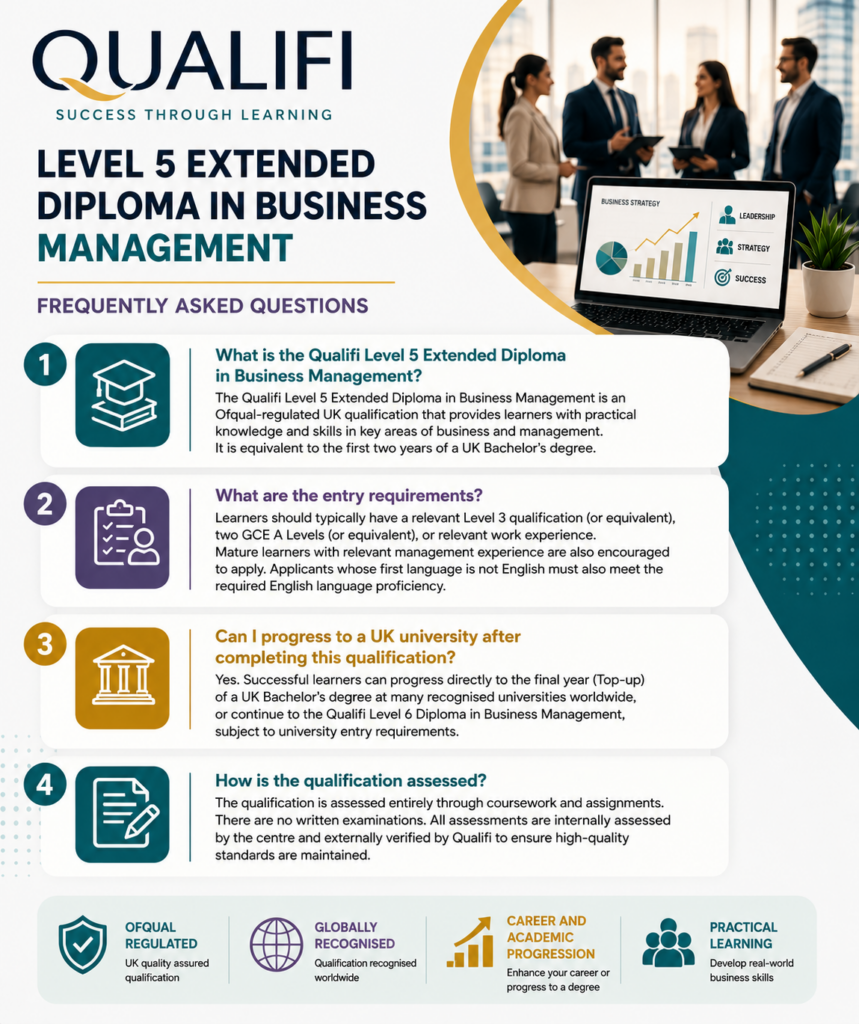
The Qualifi Level 5 Extended Diploma in Business Management equips learners with the practical knowledge, leadership skills, and business expertise needed to succeed in today's dynamic business environment. Covering key areas such as leadership, finance, operations, customer management, business development, and strategic decision-making, the qualification provides a strong foundation for career progression or progression to the final year of a UK bachelor's degree.
Entry requirements: Applicants should normally: Be at least 18 years old Hold a relevant Level 3 qualification before beginning the Level 4 component Meet the approved centre’s admission requirements Provide evidence of English-language proficiency if English is not their first language, normally equivalent to IELTS 6.0 or another accepted qualification Applications may also be considered on the basis of relevant professional experience, subject to the approved centre’s admission policy.
The OTHM Level 5 Extended Diploma in Business Management develops the practical knowledge, leadership capabilities and professional skills needed to succeed in today’s business environment. Covering areas such as business operations, finance, strategy, human resources, marketing and entrepreneurship, it provides a strong foundation for career advancement or progression to the final year of a relevant UK bachelor’s degree.
Entry requirements: The qualification is designed for learners who are typically aged 18 or above. Applicants should normally hold at least one of the following: A relevant Level 3 diploma or an equivalent qualification GCE Advanced Level qualifications in two subjects or an equivalent qualification Mature learners aged over 21 may also be considered based on relevant management experience. Applicants following this route should confirm the experience requirements with the approved delivery centre before registering. Learners who are not from a majority English-speaking country must provide evidence of sufficient English-language competency in accordance with OTHM requirements and the centre’s admissions policy.