
WhatsApp:: +44 7557430838
Email: info@theoxfordcollege.com
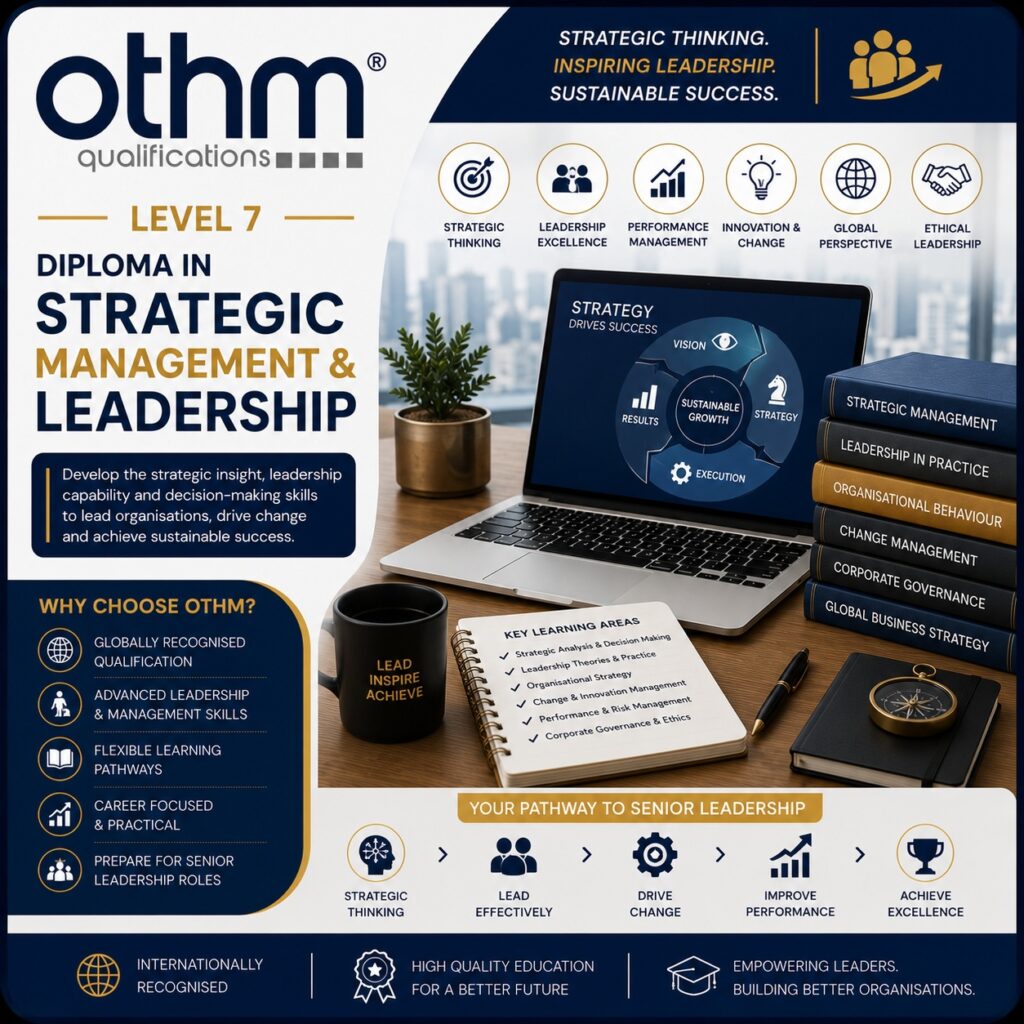

The OTHM Level 7 Diploma in Strategic Management and Leadership is a UK-regulated postgraduate qualification designed for experienced managers, senior professionals, business leaders, entrepreneurs, and aspiring executives seeking to develop advanced strategic leadership capabilities. Regulated by Ofqual (UK), this qualification is equivalent to postgraduate-level study and provides an excellent pathway to a recognised MBA Top-Up programme.
The programme develops learners' understanding of strategic management, organisational leadership, human resource management, business research, and organisational change. Combining advanced management theory with practical application, it equips learners with the knowledge and skills required to develop strategy, lead organisational transformation, manage people effectively, and make evidence-based business decisions. Throughout the course, learners will strengthen their strategic thinking, leadership, decision-making, and analytical skills to improve organisational performance and deliver sustainable business success. Graduates will be well prepared for senior management and executive leadership positions across private, public, and third-sector organisations.
This qualification is assessed entirely through coursework and assignments, enabling learners to apply strategic management theory to real organisational contexts.
Assessment methods include:
To enrol on the OTHM Level 7 Diploma in Strategic Management and Leadership, learners must meet one of the following requirements:
Applicants must normally be 21 years of age or older at the start of the programme. Learners from non-majority English-speaking countries must also provide evidence of English language competency.
The OTHM Level 7 Diploma is regulated on the Regulated Qualifications Framework (RQF) and is academically equivalent to the taught stage of a UK Master's degree. As the qualification comprises 120 credits, learners can progress to a 60-credit MBA or Master's dissertation (Top-Up) at a recognised university to achieve a full postgraduate qualification.
Upon successful completion of the OTHM Level 7 Diploma in Strategic Management and Leadership, learners may progress to:
The qualification consists of four mandatory units and two optional units, totalling 120 credits, 1,200 Total Qualification Time (TQT), and 600 Guided Learning Hours (GLH).
The qualification is designed to be completed over one academic year through full-time study. Flexible delivery options are also available, making it suitable for part-time, blended, and distance learning to accommodate the needs of working professionals.
For entry onto the OTHM Level 7 Diploma in Strategic Management and Leadership qualification, learners must possess:
An honours degree in related subject or UK level 6 diploma or an equivalent overseas qualification
Mature learners with management experience (learners must check with the delivery centre regarding this experience prior to registering for the programme)
Learners must be 21 years old or older at the beginning of the course
English requirements: If a learner is not from a majority English-speaking country must provide evidence of English language competency.
For course support, email support@theoxfordcollege.com or use the help centre inside your learner dashboard. Our support team is available Monday to Friday, 9am-5pm, and aims to respond to all queries within 24 hours.
Discover the role and purpose of financial accounting, the accounting equation, and the key principles and assumptions that underpin financial reporting.
Master the double-entry system, debits and credits, journals, and ledgers, and learn how every transaction keeps the accounting equation in balance.
Follow the full accounting cycle, including the trial balance, adjusting entries such as accruals and depreciation, and closing the books.
Learn to prepare the income statement, balance sheet, and statement of cash flows, and understand how the three statements connect.
Use ratios and analysis techniques to interpret financial statements and assess a business’s profitability, liquidity, and financial health.

No prior experience is required. The course starts with the fundamentals of accounting and gradually builds up to preparing and analysing financial statements, making it suitable for complete beginners and those refreshing their knowledge.
Yes. The course is 100% online and self-paced, so you can study anytime, anywhere, at a pace that suits you. All materials are accessible through your learner dashboard.
Yes. On successful completion you will receive a CPD-accredited digital certificate that you can download, share on LinkedIn, and add to your CV.
No specialist software is required. The course focuses on understanding accounting principles and manual preparation of accounts, though we explain how these concepts map to popular accounting software.
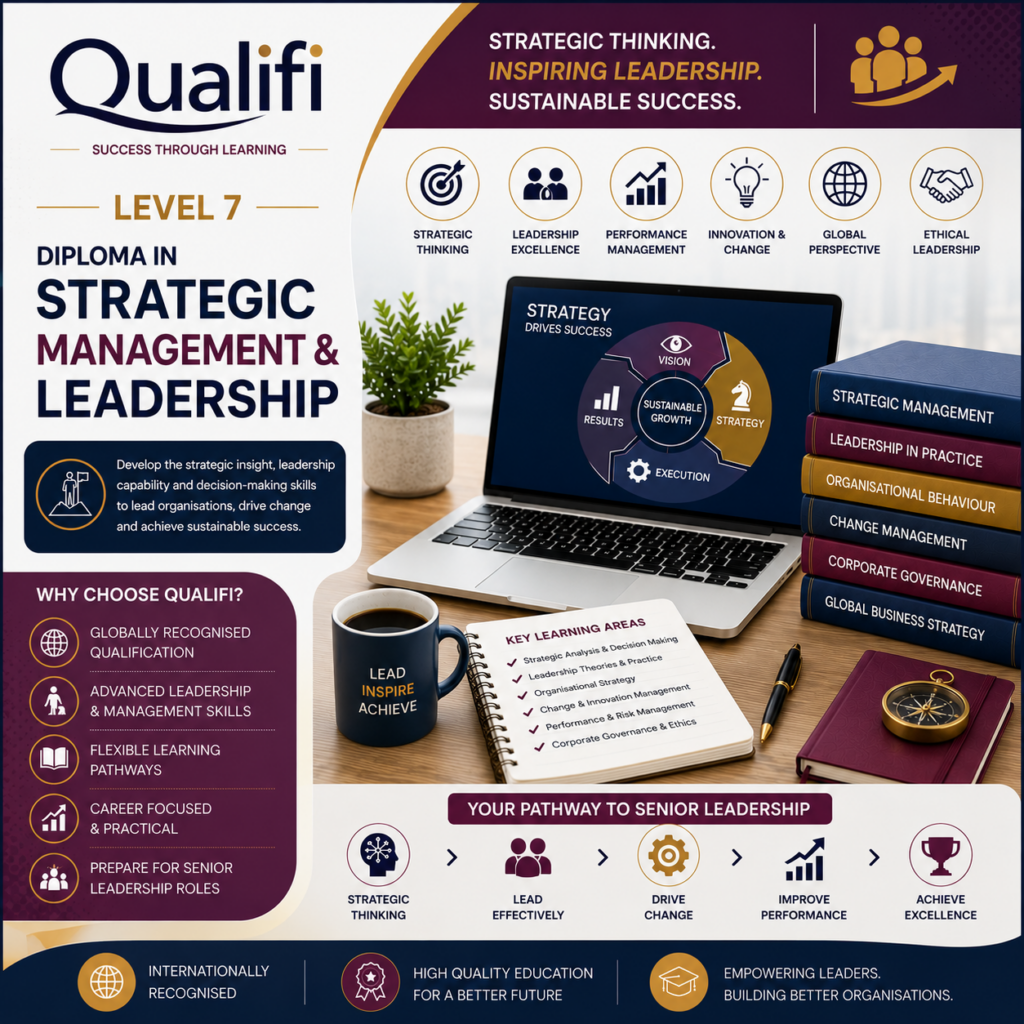
A comprehensive Qualifi Level 7 Diploma in Strategic Management and Leadership covering strategic planning, leadership, human resource management, business research, organisational change, and strategic decision-making for aspiring and experienced managers.
Entry requirements: For entry onto the Qualifi Level 7 Diploma in Strategic Management and Leadership qualification, learners must possess: An honours degree in related subject or UK level 6 diploma or an equivalent overseas qualification Mature learners with management experience (learners must check with the delivery centre regarding this experience prior to registering for the programme) Learners must be 21 years old or older at the beginning of the course English requirements: If a learner is not from a majority English-speaking country must provide evidence of English language competency.
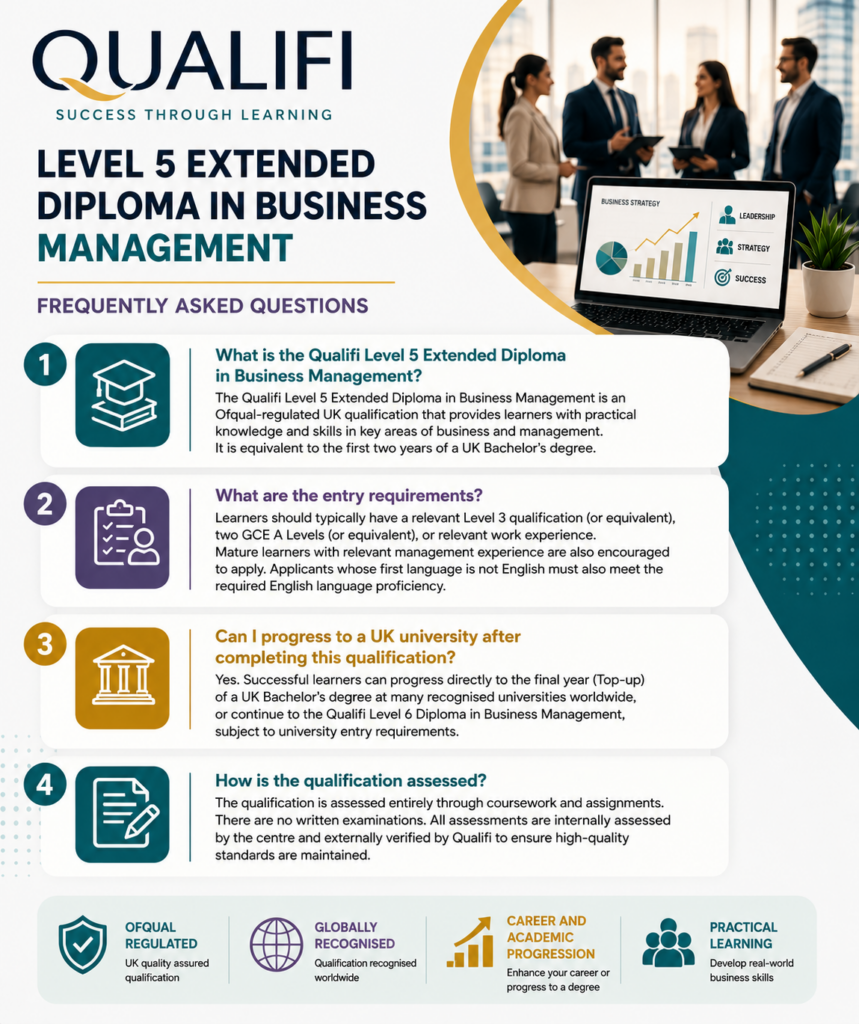
The Qualifi Level 5 Extended Diploma in Business Management equips learners with the practical knowledge, leadership skills, and business expertise needed to succeed in today's dynamic business environment. Covering key areas such as leadership, finance, operations, customer management, business development, and strategic decision-making, the qualification provides a strong foundation for career progression or progression to the final year of a UK bachelor's degree.
Entry requirements: For the QUALIFI Level 5 Extended Diploma in Business Management, the entry requirements are: Minimum age: Applicants must be 18 years or older. Academic qualification: Learners entering the Level 4 Diploma should normally hold a Level 3 qualification. Learners entering the Level 5 Diploma should normally hold a Level 4 qualification. English language: Applicants whose first language is not English must have IELTS 6.0 (or an equivalent Successful completion of the QUALIFI Level 5 Extended Diploma in Business Management provides learners with the practical knowledge, leadership skills, and commercial awareness required to pursue a wide range of careers in business and management across public, private, and third-sector organisations. Graduates may progress into roles such as: Business Manager Operations Manager Project Manager Human Resources Manager Marketing Manager Business Development Manager Customer Relationship Manager Office or Administration Manager Retail or Sales Manager Entrepreneur / Business Owner The qualification also provides an excellent pathway for learners wishing to continue their academic journey. Successful graduates can progress to the final year (Top-up) of a UK Bachelor's degree at a range of recognised universities or continue their professional development through higher-level management qualifications.English language qualification). International applicants: International qualifications will be assessed for suitability for entry to UK higher education programmes where applicable.
A comprehensive blended learning programme covering educational leadership, management theory, policy, pedagogy, organisational change, reflective practice, intercultural communication, and research methods, equipping you with the strategic knowledge and practical skills to lead educational organisations and advance your career.
Entry requirements: There are no formal prerequisites for this course. It is suitable for beginners, business owners, and professionals looking to upskill. A basic understanding of business concepts and good written English are recommended. Learners will need a computer with a stable internet connection to access the online materials.

David –
★★★★★ Highly recommended for aspiring leaders
“The OTHM Level 7 Diploma has been an outstanding experience from start to finish. The course content was practical, engaging, and directly relevant to my role. The lecturers were incredibly professional and supportive, making complex strategic concepts easy to understand. I now feel much more confident leading projects and making strategic decisions within my organisation.”
Emma –
★★★★★ A perfect stepping stone to my MBA
“This course provided an excellent foundation for my postgraduate studies. The professionalism of the tutors and the quality of the learning materials exceeded my expectations. Thanks to the knowledge and confidence I gained, I have successfully progressed to an MBA in the UK. I would highly recommend this diploma to anyone looking to advance their career.”
Sophie –
★★★★★ Practical knowledge that I use every day
“I appreciated how the programme focused on real business challenges rather than just theory. Every module gave me tools I could immediately apply in the workplace. The support from the course team was exceptional, and completing the diploma helped me secure a promotion into a senior management position.”