

WhatsApp:: +44 7557430838
Email: info@theoxfordcollege.com

Overview
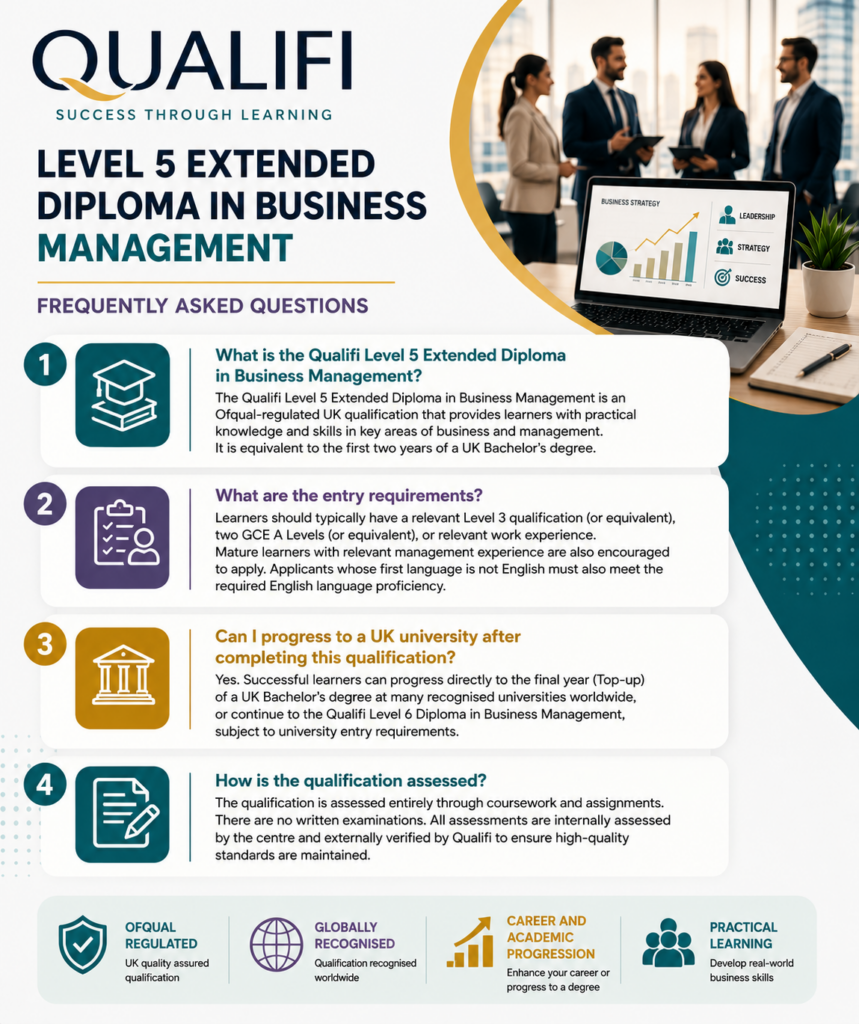
The QUALIFI Level 5 Extended Diploma in Business Management is a UK-regulated qualification designed to develop the knowledge, skills and professional competencies required for successful careers in business and management. Regulated by Ofqual (UK), this qualification combines Level 4 and Level 5 study, providing learners with a strong academic foundation and practical management skills that prepare them for employment or progression to the final year of a bachelor's degree.
The qualification has been developed to prepare future business managers by enhancing analytical thinking, leadership, decision-making and problem-solving skills. Learners gain practical knowledge that can be applied across a wide range of industries while developing the confidence to manage people, operations and organisational change.
Successful completion enables learners to:
Assessment is entirely assignment-based. Learners complete written assignments for every unit, which are internally assessed by the approved centre and externally quality assured by QUALIFI. There are no written examinations, allowing learners to demonstrate their understanding through practical business scenarios and workplace-based research where appropriate.
Applicants should normally:
The qualification consists of 240 credits, combining Level 4 and Level 5 study. It is academically comparable to a Foundation Degree and is designed to provide entry into the final year of an Honours Degree at a range of UK universities through recognised progression pathways.
After successful completion, learners may progress to:
The qualification consists of 12 mandatory units worth a total of:
The qualification is designed for flexible study and can typically be completed within 12 to 24 months, depending on the learner's chosen mode of study. It is suitable for classroom, blended or online delivery through approved QUALIFI centres.
This qualification provides an excellent pathway for learners seeking a recognised UK business qualification that combines academic study with practical management skills, offering clear progression to university top-up degrees and enhanced career opportunities in business and management.
For the QUALIFI Level 5 Extended Diploma in Business Management, the entry requirements are:
Minimum age: Applicants must be 18 years or older.
Academic qualification:
Learners entering the Level 4 Diploma should normally hold a Level 3 qualification.
Learners entering the Level 5 Diploma should normally hold a Level 4 qualification.
English language: Applicants whose first language is not English must have IELTS 6.0 (or an equivalent Successful completion of the QUALIFI Level 5 Extended Diploma in Business Management provides learners with the practical knowledge, leadership skills, and commercial awareness required to pursue a wide range of careers in business and management across public, private, and third-sector organisations.
Graduates may progress into roles such as:
Business Manager
Operations Manager
Project Manager
Human Resources Manager
Marketing Manager
Business Development Manager
Customer Relationship Manager
Office or Administration Manager
Retail or Sales Manager
Entrepreneur / Business Owner
The qualification also provides an excellent pathway for learners wishing to continue their academic journey. Successful graduates can progress to the final year (Top-up) of a UK Bachelor's degree at a range of recognised universities or continue their professional development through higher-level management qualifications.English language qualification).
International applicants: International qualifications will be assessed for suitability for entry to UK higher education programmes where applicable.
For course support, email support@theoxfordcollege.com or use the help centre inside your learner dashboard. Our support team is available Monday to Friday, 9am-5pm, and aims to respond to all queries within 24 hours.
This unit is divided into three parts and examines Communications at an organisational level, interpersonal communications and managing internal and external communications. Effective communications are vital to the success of any organisation, to ensure understanding, involvement and commitment to organisational policies and procedures. Organisations today often need to change their policies and procedures to survive in the developing local and global economies. It is important for managers to realise the importance of sound communication practice and systems to ensure the effective development and dissemination of new ideas and decisions for change. This unit will help managers explore the links between good communications and the development of workforce understanding and commitment to change by considering what is meant by good communications practice. It will then help them look at their communication skills as well as how to improve links between their team, other parts of the organisation and beyond.
This unit looks at the development of practical leadership skills at a non-strategic level within the rapidly changing working environment. The unit provides an opportunity for learners to explore in depth the attributes and skills of successful leaders. Learners will also be able to consider how some of the leadership theories and models can be applied to specific situations and to learn how leadership skills can be developed. The unit draws on a selection of established principles and on more recent work. It seeks to consider their relevance to specific working situations.
This unit is designed to introduce learners to the nature, role and importance of financial information in organisations from a managerial perspective. Learners will have the opportunity to look at communication and interpretation of financial information for managing organisations, its regulation and structuring and use in decision making, together with the principles of accounting, standards expected, and concepts and conventions that influence the presentation of financial information. Learners will, through the examination of financial information, learn about the important issues relating to the measurement of efficiency, profitability and solvency, and the different demands on organisations made by different stakeholders. They will also explore the extent to which external confidence is determined by financial performance. Learners will examine how financial information can be interpreted, analysed and evaluated, how costs in an organisation can be monitored and controlled, and how the concept of contribution aids decision making.
Management has often been defined as ‘creating change through people’ and this unit encourages learners to adopt this approach to change. It is designed for managers or potential managers working at first line or operational levels who are seeking to change ongoing systems and processes in the workplace. Learners will gain the realisation that it is only through the people that they work with that change can become successful. This unit will allow learners to take a problem solving approach, initially defining issues and then looking at options, before selecting an appropriate route to change. Finally, the unit looks at planning for implementation and evaluation of the change itself. There will be an emphasis on involving those directly affected, to gain their experience and knowledge as well as their commitment to, and ownership of, the change itself. Throughout the unit, importance will be placed the need to manage and control the change process by effective monitoring and evaluation. Various change models will be used as the basis of activity.
This unit focuses upon the effective and efficient planning and management of work activities. It provides learners with the knowledge and skills to design, implement and change operational plans to improve effectiveness and efficiency, and to design and monitor appropriate systems to ensure quality of the products and services. Learners may investigate their own organisation and their role within it. Their research will involve evaluating the importance of business processes in delivering outcomes based on business goals and objectives, establishing customer requirements and developing and implementing operational plans to meet them. This will include the identification of resources needed, the planning and allocation of appropriate work activities, the setting and monitoring of performance measures and quality standards, and then taking appropriate action or making suitable recommendations to solve problems at work and managing the resulting change. Consideration will be given throughout the unit to legal, regulatory and ethical requirements, particularly to the maintenance of health and safety. Learners will discover that the objectives of successful managers are largely achieved through others and that the involvement of teams, peers and individuals is crucial to the efficient and effective management of activities.
This unit focuses on building, developing and supporting teams to enable them to achieve their goals and objectives. Learners must identify the skills and potential of team members while providing opportunities for them to gain new skills and experiences. Learners will evaluate team roles and their importance when allocating team members to appropriate tasks in order to achieve objectives. A key factor in a winning team is the team leader. Learners will have the opportunity to examine the qualities required of an effective leader to ensure that tasks are achieved, while building and developing the team and individuals within it. This unit also focuses on methods for monitoring team performance and approaches for handling poor performance and conflict.
The three key themes to this unit examine the socio-economic environment, the way in which markets operate and the relationship between business and governments. The central theme to the unit is the changing roles that exist between business, government and their citizens that create both opportunities and threats for the modern organisation. By understanding the organisational impact of the trends, managers can respond positively to a changing socio-economic environment. The unit also looks at the external business environment and the different ways that organisations respond to changes.
The unit will look at the different ways that decisions are taking by companies by exploring approaches to decision making, implementing decisions and the way in which knowledge can be used within organisations. With the growth of IT and customisation, few decisions are straightforward enough for managers to rely on the answers that have been successful in past years. To remain competitive, organisations need to develop decision-making processes that use all the current information and knowledge available in the workplace, workforce and beyond. Consequently, today’s decision making becomes more of a problem-solving process. In addition, increasing workforce empowerment and expectation means that the decision- making process for competitive organisations needs to be a much more participative process. Otherwise, management will not gain the information and knowledge they need and will also lose the commitment required to ensure decisions taken become effective. So, while the act of decision taking effectively remains with the manager responsible, the process of decision making needs to involve all the stakeholders within the managers’ immediate workplace and beyond. This ensures that the decision taken is owned by all whom have to work with it.
The unit will allow for learners to work in a team to investigate new business formats and a feasibility assessment for a potential knowledge-based product or service opportunity identified by the team. This might be undertaken for a new income stream within an existing business or for a new enterprise. The core unit material will focus on Refining an Idea, Research and Presenting the Plan. All learners will be involved with refining the idea and individual learners will be responsible for doing market research, building a finial plan and creating an operational plan.
The unit is designed to help learners understand what is expected from them in working for a growing organisation. The final three units explore the relationship between enterprising behaviour and business success, the different ways in which firms can grow and the different types of business that they might be expected to work in.
This unit is designed to help learners understand the role of customer-centred organisations. The three units are understanding customers, meeting customer need and adding value. Learners will evaluate best practice and the policies and approaches that result in excellent service and delivery within a contemporary business environment. Customer Relationship Management (CRM) is now being actively embraced by organisations within most industry sectors. Furthermore, customer expectations are changing with the result that customer relationships are becoming increasingly more complex to manage. This unit analyses how businesses have responded by looking after their customer base in new and more cost effective ways.
This unit prepares learners for working in a commercial environment by providing an insight into the different risk profiles from both an organisation’s and an individual’s perspectives. The three units are understanding business risk, managing risk and innovation and creativity. The aim is to provide learners with an understanding of what makes an effective organisation in balancing out opportunity with change.

This qualification is designed for learners who want to develop practical knowledge and skills in the subject area, whether they are progressing from previous studies, looking to advance their career, or preparing for further higher education.
Yes. Qualifi is a UK awarding organisation regulated by Ofqual (Office of Qualifications and Examinations Regulation). Qualifi qualifications are recognised internationally and are designed to support progression to higher-level study and professional development.
Assessment is based on assignments rather than traditional examinations. Learners complete coursework that demonstrates their understanding and application of the learning outcomes, which is internally assessed and quality assured.
Upon successful completion, learners may progress to higher-level Qualifi qualifications, relevant university top-up programmes (subject to university entry requirements), or enhance their career opportunities within their chosen field.
Yes. Successful learners are eligible to progress directly to the final year (Year 3) of many UK Bachelor's degree programmes or continue to the Qualifi Level 6 Diploma in Business Management, subject to university entry requirements.
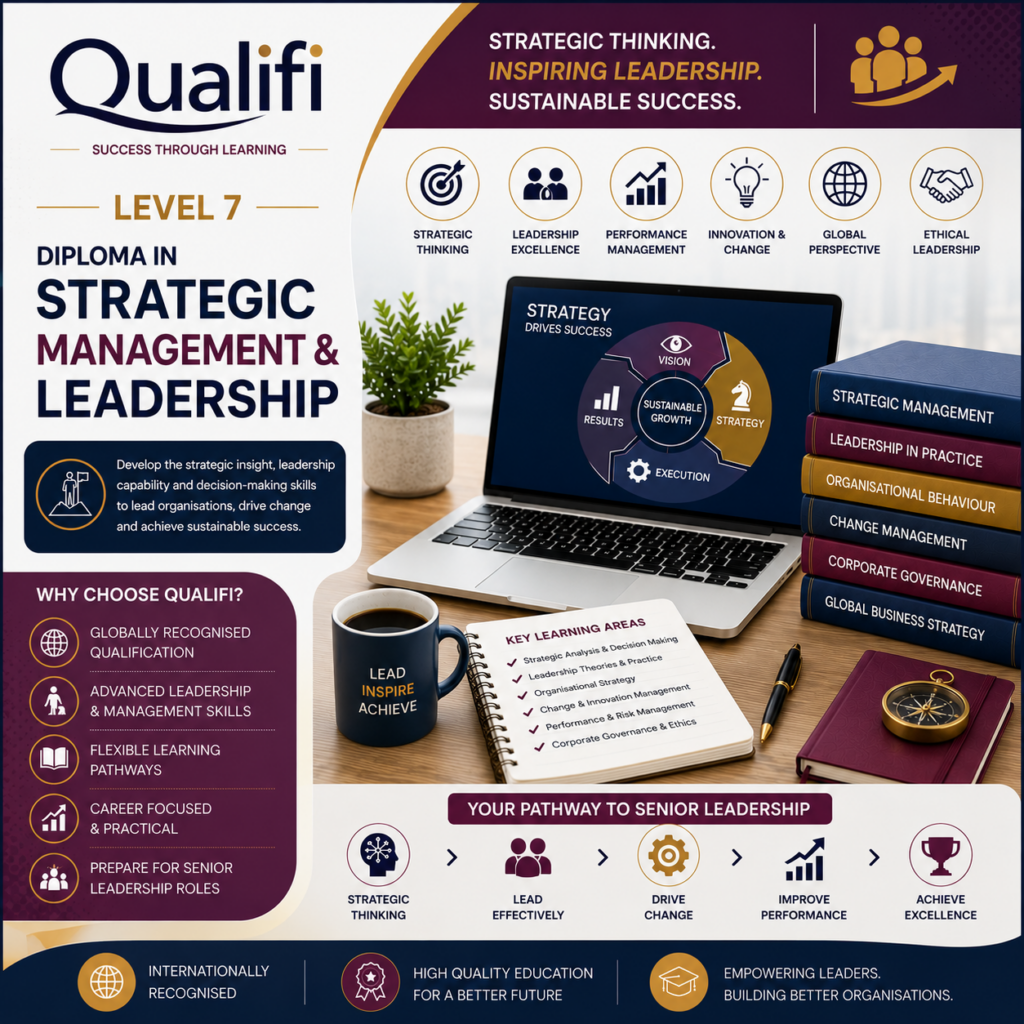
A comprehensive Qualifi Level 7 Diploma in Strategic Management and Leadership covering strategic planning, leadership, human resource management, business research, organisational change, and strategic decision-making for aspiring and experienced managers.
Entry requirements: For entry onto the Qualifi Level 7 Diploma in Strategic Management and Leadership qualification, learners must possess: An honours degree in related subject or UK level 6 diploma or an equivalent overseas qualification Mature learners with management experience (learners must check with the delivery centre regarding this experience prior to registering for the programme) Learners must be 21 years old or older at the beginning of the course English requirements: If a learner is not from a majority English-speaking country must provide evidence of English language competency.
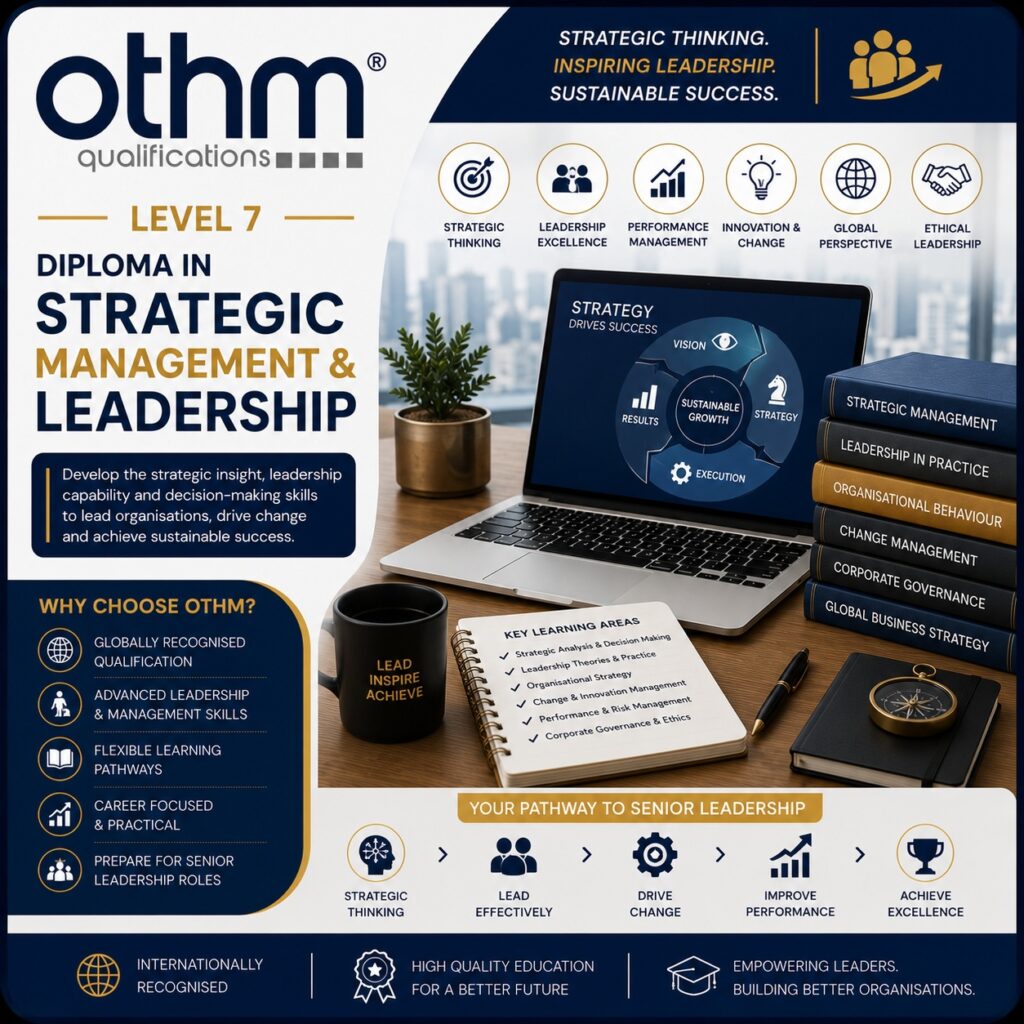
A comprehensive OTHM Level 7 Diploma in Strategic Management and Leadership covering strategic planning, leadership, human resource management, business research, organisational change, and strategic decision-making for aspiring and experienced managers.
Entry requirements: For entry onto the OTHM Level 7 Diploma in Strategic Management and Leadership qualification, learners must possess: An honours degree in related subject or UK level 6 diploma or an equivalent overseas qualification Mature learners with management experience (learners must check with the delivery centre regarding this experience prior to registering for the programme) Learners must be 21 years old or older at the beginning of the course English requirements: If a learner is not from a majority English-speaking country must provide evidence of English language competency.
The OTHM Level 5 Extended Diploma in Information Technology provides learners with a strong foundation for a successful career in the IT industry. Designed to develop confident, independent, and business-ready professionals, the programme equips learners with practical technical knowledge and the adaptability needed in today's fast-changing technology sector. It is ideal for those starting or advancing a career in IT and provides a pathway to further university study or employment.
Entry requirements: These qualifications are designed for learners who are typically aged 18 and above. The entry profile for learners is likely to include at least one of the following: Relevant Level 3 Diploma or equivalent qualification ● GCE Advanced level in 2 subjects or equivalent qualification ● Mature learners (over 21) with relevant management experience (learners must check with the delivery centre regarding this experience prior to registering for the programme)


Reviews
There are no reviews yet.