WhatsApp:: +44 7557430838
Email: admin@theoxfordcollege.com
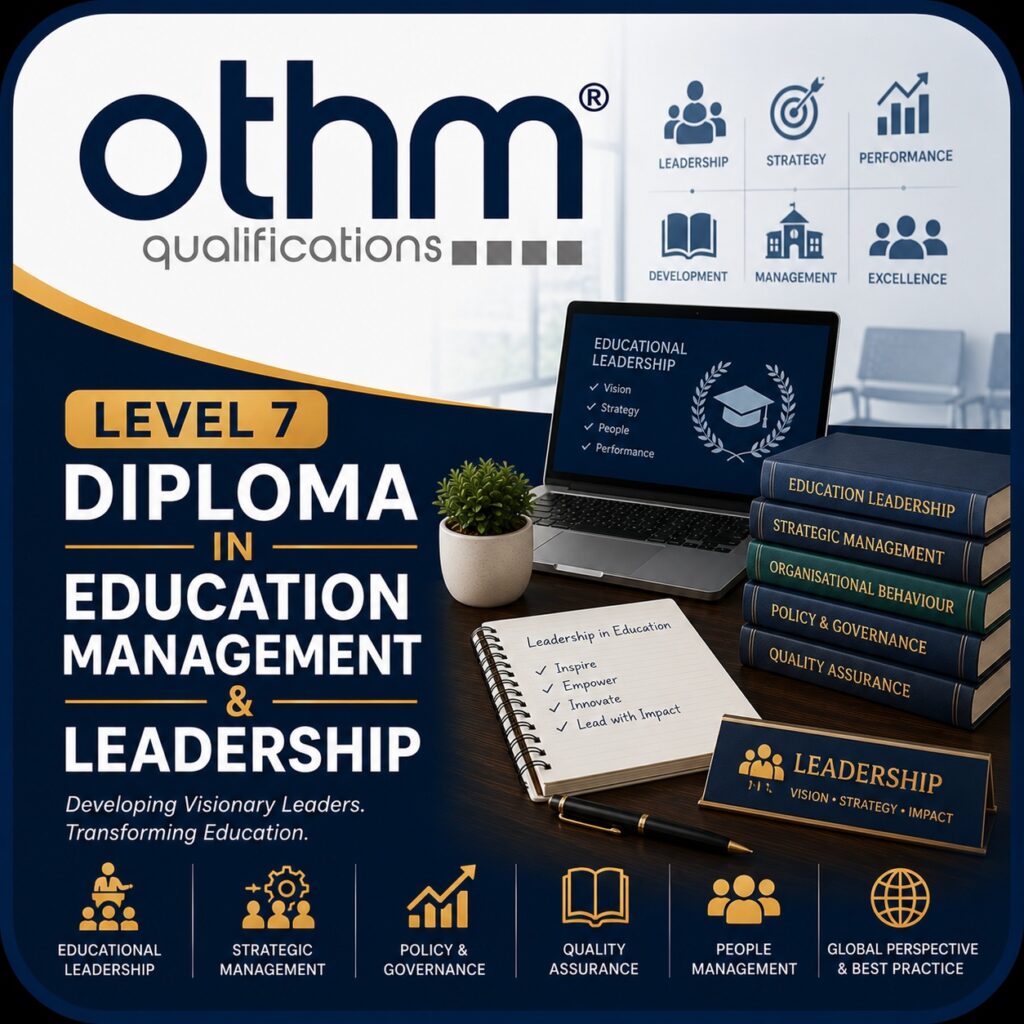

The OTHM Level 7 Diploma in Education Management and Leadership is a UK-regulated postgraduate-level qualification for experienced educators, academic leaders, education managers, and professionals aspiring to senior leadership positions within the education sector.
Regulated by Ofqual, the qualification provides a recognised pathway to eligible master’s top-up programmes. It is designed to develop the advanced knowledge and practical skills required to lead educational institutions and respond effectively to the evolving challenges facing the sector.
The programme explores educational policy, management theory, and professional practice, with a strong focus on leadership, strategic management, organisational change, pedagogy, research, intercultural communication, and reflective practice.
Throughout the programme, learners will strengthen their leadership, management, analytical, and decision-making abilities. Graduates will be prepared to drive organisational improvement and pursue leadership and management roles across schools, colleges, universities, training providers, and other educational organisations.
The qualification is assessed entirely through coursework and assignments, enabling learners to apply academic theory to real-world educational settings.
Assessment methods may include:
Applicants must normally meet one of the following requirements:
Applicants should normally be at least 21 years old at the start of the programme.
The OTHM Level 7 Diploma in Education Management and Leadership is regulated on the UK Regulated Qualifications Framework at Level 7. It is academically equivalent to the taught stage of a UK master’s degree.
The qualification comprises 120 credits. After completing the diploma, eligible learners may progress to a 60-credit master’s dissertation or top-up programme at a recognised university to earn a full master’s degree. Admission and credit-transfer arrangements are determined by the receiving university.
After successfully completing the qualification, learners may progress to:
The qualification consists of six mandatory units and provides:
The qualification is designed to be completed in one academic year through full-time study.
Flexible delivery options may also be available, including part-time, blended, and distance learning. These options make the programme suitable for working professionals who need to balance their studies with personal and professional commitments.
Entry Requirements
Applicants must normally meet one of the following requirements:
Hold an honours degree in a related subject, a UK Level 6 diploma, or an equivalent overseas qualification
Be a mature learner with relevant management experience, subject to approval by the delivery centre
Applicants should normally be at least 21 years old at the start of the programme.
For course support, email support@theoxfordcollege.com or use the help centre inside your learner dashboard. Our support team is available Monday to Friday, 9am-5pm, and aims to respond to all queries within 24 hours.
This unit develops an understanding of how educational leaders can plan, manage and support organisational change. Learners investigate issues that create a need for change, examine established change management models and evaluate the potential impact of proposed initiatives. They also develop the leadership skills required to communicate change, address resistance, engage stakeholders and support improvement within their own educational context.
This unit examines the importance of effective intercultural communication within national and international education settings. Learners explore cultural perspectives, communication theories and the challenges created by an increasingly connected world. They develop strategies for overcoming communication barriers, supporting inclusion and managing diverse educational environments while considering how culture and communication can influence educational policy and practice.
This unit provides learners with a strong theoretical and practical understanding of teaching, learning and assessment. It examines subject specific pedagogy, the relationship between knowledge, policy, theory and practice, and the ways educational enquiry can improve teaching. Learners evaluate different pedagogical approaches and apply their findings to enhance learner engagement and professional practice within their own educational setting.
This unit develops an understanding of reflective practice and its role in improving educational provision. Learners examine key theories and models of reflection, evaluate their own professional practice and use the results to plan personal development. The unit also focuses on supporting colleagues through feedback, observation, mentoring and continuing professional development, enabling learners to lead reflective practice across an educational organisation.
This unit develops the research skills required to investigate issues within educational settings and support evidence based decision making. Learners examine research philosophies and approaches, evaluate existing educational research and design an ethical research proposal. They also develop skills in collecting, analysing and interpreting data and explore how research evidence can contribute to improvements in teaching, learning, assessment and educational management.
This unit explores the relationship between educational research, theory, policy and professional practice. Learners examine contemporary issues affecting education, evaluate the impact of policy changes on teaching and learning, and consider the importance of quality management and continuous improvement. The unit also develops the ability to analyse stakeholder needs and apply current research to improve educational provision.

It is a UK regulated postgraduate qualification designed to develop advanced knowledge of educational policy, management theory, leadership, organisational change, pedagogy, reflective practice and research. The qualification is approved and regulated by Ofqual and carries 120 credits.
Applicants should normally hold an honours degree in a related subject, a UK Level 6 Diploma or an equivalent overseas qualification. Mature applicants with relevant management experience may also be considered, subject to approval by the delivery centre. Learners must normally be at least 21 years old when the course begins and may need to provide evidence of English language competency.
The qualification is assessed through coursework rather than written examinations. Assessment methods include reports, case studies, research projects and personal development planning. All units are internally assessed by the approved delivery centre and externally verified by OTHM.
Graduates may progress into education management and leadership roles or continue their studies through a recognised Master’s Top Up programme in the UK or overseas. As the diploma is worth 120 credits, learners will normally need to complete a further 60 credit dissertation stage at a university to achieve a full master’s degree.
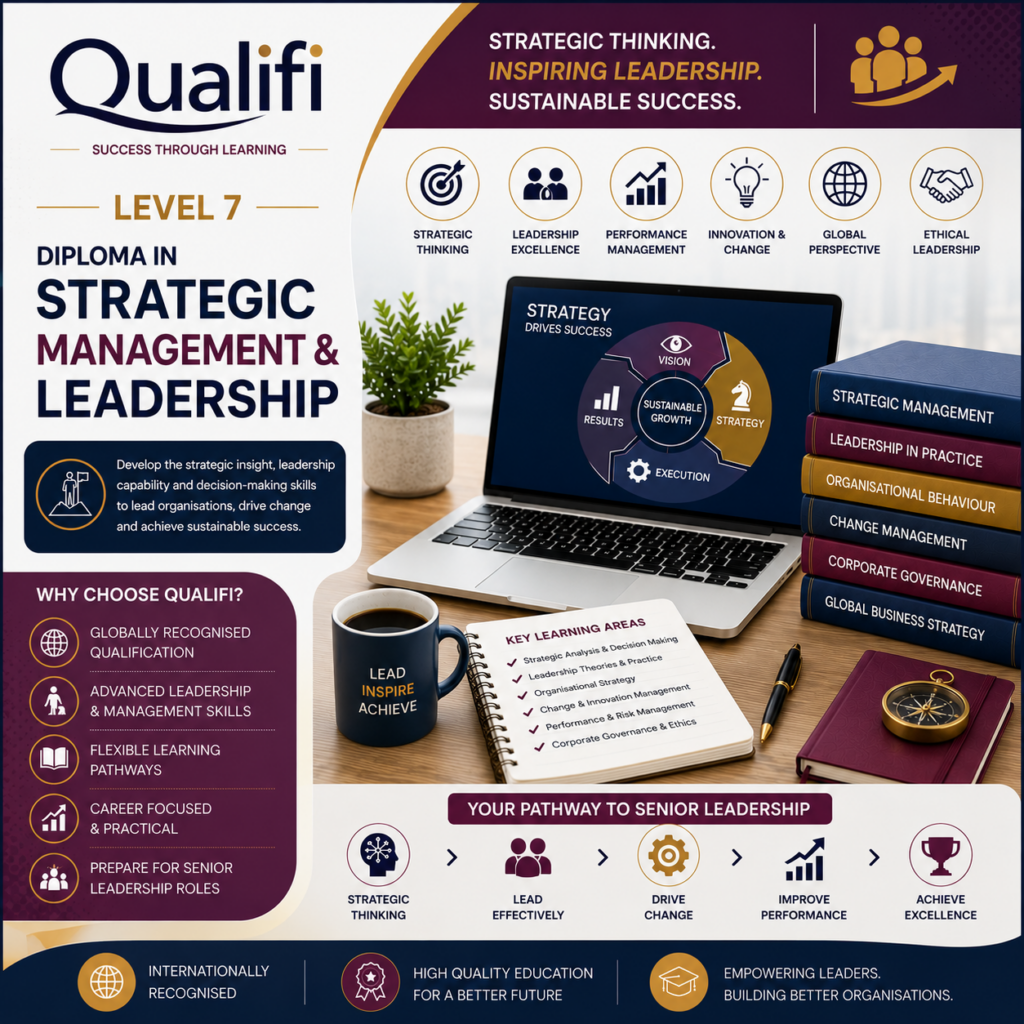
A comprehensive Qualifi Level 7 Diploma in Strategic Management and Leadership covering strategic planning, leadership, human resource management, business research, organisational change, and strategic decision-making for aspiring and experienced managers.
Entry requirements: Applicants should normally: Hold a Level 6 qualification or a recognised bachelor’s degree Be at least 19 years old Demonstrate English-language proficiency, such as IELTS 6.0 or an equivalent qualification, if English is not their first language Applicants who have substantial management experience but do not hold formal qualifications may also be considered, subject to an interview and assessment by the approved delivery centre.
Develop essential expertise in educational leadership, management, policy, pedagogy, organisational change, intercultural communication, and research through flexible blended learning. Gain the practical skills and confidence to improve organisational performance and lead effectively across diverse educational settings.
Entry requirements: Applicants must: Hold a relevant vocational or academic qualification at least one level above that of their learners Ideally hold a minimum Level 3 qualification in their specialist subject Have access to at least 100 hours of teaching practice Demonstrate appropriate literacy, language, numeracy, and ICT skills Be at least 19 years old at the start of the course
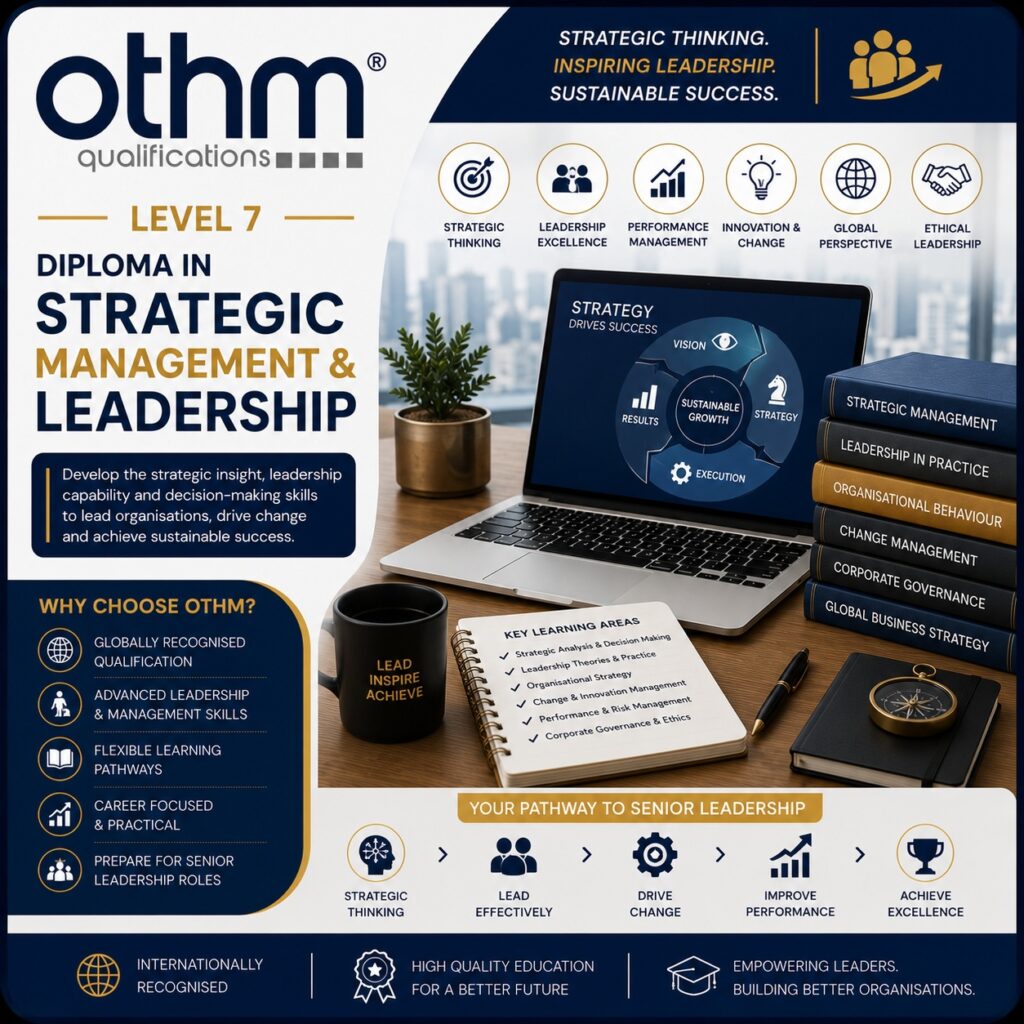
A comprehensive OTHM Level 7 Diploma in Strategic Management and Leadership covering strategic planning, leadership, human resource management, business research, organisational change, and strategic decision-making for aspiring and experienced managers.
Entry requirements: Applicants must meet one of the following entry requirements: Hold an honours degree in a related subject, a UK Level 6 diploma, or an equivalent overseas qualification; or Be a mature learner with relevant management experience, subject to approval by the delivery centre. Applicants must normally be at least 21 years old at the beginning of the programme. Learners from countries where English is not the majority language must also provide evidence of English-language proficiency.